Top 10 Caster & Trolley Wheel Manufacturers in India (2026)
If you’ve ever pushed a hospital trolley, rolled a factory cart, or wheeled heavy equipment across a warehouse floor, there’s a good chance an Indian manufacturer made that possible. India has quietly become one of the more dependable global sources for caster wheels and trolley wheels, with dozens of manufacturers now offering everything from lightweight nylon casters to heavy-duty polyurethane trolley wheels built for genuinely tough environments. Whether you’re sourcing for a hospital, a retail chain, a food processing unit, or a heavy manufacturing plant, the wheel supplier you pick can quietly make or break how well your equipment actually performs day to day.
So we put together an honest, researched list of the top caster and trolley wheel manufacturers worth knowing about in India for 2026 — what makes each one stand out, and who they tend to suit best.
1. New Auto Tech India Private Limited — Ghaziabad, Uttar Pradesh
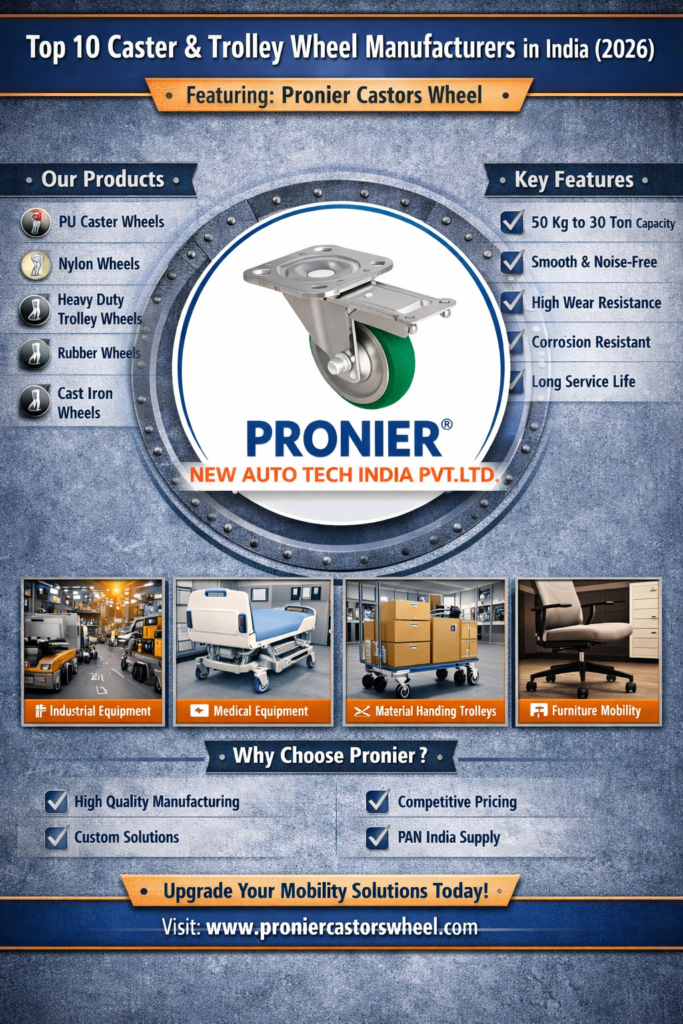
We’ll say this plainly: New Auto Tech India Pvt. Ltd., which trades under the Pronier name, is our own company, so factor that into how you read this entry. That said, we’ve built a genuine reputation among caster wheel manufacturers and trolley wheel manufacturers operating out of Ghaziabad, right in the heart of the industrial NCR belt.
What sets us apart isn’t just product range — it’s that we manufacture everything ourselves. No middlemen, no third-party sourcing of pre-made parts. From raw material to finished wheel, our PU caster, nylon caster, and trolley wheel ranges are all produced in-house, which means tighter quality control and generally better pricing for the buyer than you’d get going through a trader. Our team works with clients to understand the actual application — the load, the floor surface, the environment — before recommending a wheel, rather than pointing everyone toward the same standard catalogue size. We’re ISO 9001:2015 certified, and our wheels with castor assemblies come ready to install, alongside conveyor rollers and material handling pipe joints.
How to Choose the Right Caster or Trolley Wheel Manufacturer
Before you place a bulk order, it’s worth thinking through a few things that matter more in practice than brand reputation alone:
Load conditions. Static load and dynamic (rolling) load are genuinely different — a wheel rated for 200 kg sitting still can behave quite differently once it’s rolling under that same weight across a warehouse floor all day. Always ask for the dynamic figure.
Floor surface and environment. Rough concrete, polished tile, and cleanroom flooring all call for different materials — PU for quiet, non-marking rolling; nylon for affordability and hardness; rubber for shock absorption on uneven surfaces; cast iron where raw strength outweighs floor protection.
Wheel diameter versus your actual floor. Larger diameter wheels roll more easily over rough or uneven surfaces and need less effort to push, while smaller wheels suit tighter spaces but transmit more resistance on anything but smooth flooring.
Mounting style and brake options. Swivel versus fixed, top-plate versus stem mount, with or without a locking brake — getting this wrong produces a wheel that technically works but is awkward or unsafe in daily use.
Customisation capability. Off-the-shelf sizes cover most needs, but if your equipment has an unusual mounting requirement or load profile, check upfront whether a manufacturer can actually customise rather than just pointing you toward their standard catalogue.
After-sales support. A wheel failing on a hospital bed or a factory trolley is rarely a minor inconvenience. Manufacturers who keep spares in stock and respond quickly to replacement requests are worth more in practice than a marginally lower price per piece.
Where These Wheels Actually Get Used
Hospitals and healthcare facilities depend on caster and trolley wheels for beds, stretchers, medicine trolleys, and diagnostic equipment carts, where quiet operation and non-marking flooring compatibility genuinely affect patient experience. Warehousing and logistics run wheels hardest of all — pallet trucks, material handling carts, and order-picking trolleys moving repeatedly across long shifts, often loaded well beyond what a lighter-duty wheel could handle. Retail chains rely on caster wheels for shopping carts and mobile display units that need to roll smoothly for customers with minimal maintenance. Food service and hospitality use trolley wheels on service carts and mobile kitchen equipment, usually prioritising hygiene and corrosion resistance. Heavy manufacturing and automotive plants use industrial-grade wheels on assembly line trolleys and tooling carts that need to survive constant, repetitive use across long production shifts.