If you’ve ever pushed a loaded trolley across a hospital corridor or a factory floor and felt it roll smooth and quiet instead of clattering and squeaking, there’s a good chance a well-made PU wheel was doing the work underneath. Polyurethane caster wheels have become the default choice wherever load capacity, floor protection, and quiet operation all matter at the same time — which is most places, honestly. Hospitals want wheels that won’t wake patients or scuff polished floors. Warehouses want wheels that can carry serious weight without cracking. Retail chains want something that rolls easily without leaving black marks across a showroom floor. PU manages to do all three reasonably well, which is exactly why it’s become the go-to material across so many industries in India.
The catch is that not every manufacturer making PU wheels is making them the same way. Tread hardness, bonding quality between the polyurethane and the core, bearing type — these details decide whether a wheel lasts three years or three months, and they rarely show up clearly in a product listing. Below is a rundown of 10 PU caster wheel manufacturers worth knowing about if you’re sourcing in India right now.
1. New Auto Tech India Private Limited — Ghaziabad, Uttar Pradesh
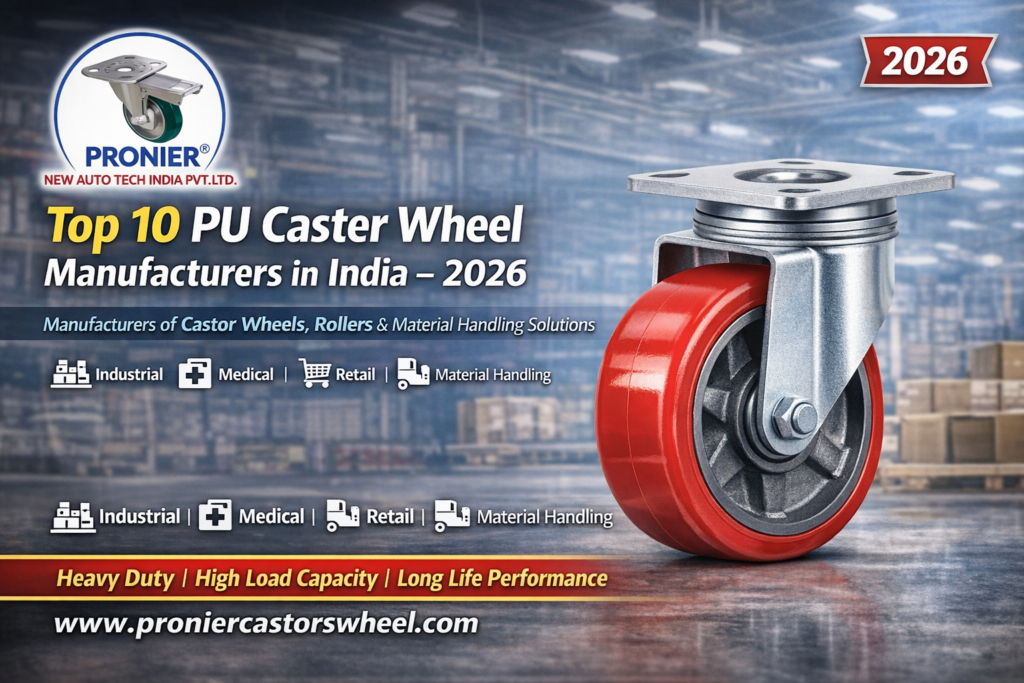
New Auto Tech India Pvt. Ltd., trading as Pronier, is one of the more established PU caster wheel manufacturers operating out of Ghaziabad, alongside our nylon caster wheel and trolley wheel lines. What actually matters here is that we don’t buy in pre-moulded PU treads from a third party and just assemble them onto a hub — we control the polyurethane formulation, the bonding process, and the bearing selection ourselves, which is the part that determines whether a wheel holds up under repeated heavy loading or starts flat-spotting within a year.
We’re ISO 9001:2015 certified, and our PU line covers everything from light swivel casters for hospital carts to heavy-duty industrial wheels rated for serious tonnage. Our full product range and wheels with castor assemblies are built to be matched to your actual application rather than sold off a generic size chart.
What Actually Separates a Good PU Wheel From a Bad One
A “top 10” list tells you who’s out there, not which wheel is right for your specific job. A few things genuinely matter more than brand name when you’re comparing PU caster wheel manufacturers:
Tread-to-core bonding. This is the single biggest failure point in cheap PU wheels — the polyurethane tread separates from the metal or nylon core under repeated heavy loading, and the wheel starts to look like it’s peeling. A well-bonded wheel simply won’t do this regardless of how many years it runs.
Polyurethane hardness (durometer). Softer PU is quieter and gentler on floors but wears faster and handles less load. Harder PU carries more weight and lasts longer under heavy use but transmits more noise and vibration. The right hardness depends entirely on your floor and load — there’s no universal “best” answer here.
Bearing quality. Just like with nylon wheels, the bearing inside the hub is often what fails before the tread material does. A cheap bearing seizes, and suddenly you’re dragging a wheel instead of rolling it.
Non-marking claims. Not every PU wheel that’s advertised as “non-marking” actually holds up to that claim once it’s been rolling on a warm factory floor for a few months. Ask for a sample and test it on your actual flooring before committing to a bulk order.
Where PU Caster Wheels Get Used the Most
Hospitals lean on PU heavily for beds, stretchers, and equipment trolleys specifically because of the quiet, non-marking rolling — nobody wants a squeaky wheel outside a patient’s room at 2 a.m. Warehouses and logistics operations use heavier-rated PU wheels on pallet trucks and material handling equipment where load capacity has to hold up shift after shift. Retail and hospitality use PU on shopping carts, display units, and hotel service trolleys where the wheel needs to look good as well as perform. Food processing and pharma facilities lean on PU’s corrosion resistance and easy-clean surface for equipment that moves through wash-down areas regularly. Automotive and heavy manufacturing plants use industrial-grade PU wheels on assembly line trolleys and tooling carts where the wheel needs to survive constant use without maintenance downtime.